We would like to share our brand new video with our song recorded in the studio for our classes and our readers! We used this video in our classes to show the children who have learned body parts, how we put a frosty together! We also put the parts which were cut and colored to make frosty as a craft! Hope you enjoy!
Instead of just sharing holiday posts with suggested activities like we normally do, I decided to share my personal discovery and journey through Christmas traditions of my own country, Brazil and Hispanic countries, when I research the topic to bring to my classes.
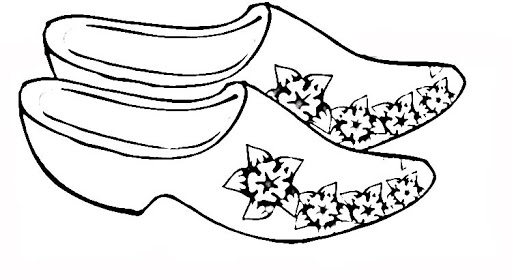
My first stop will be the Shoe on the Window tradition!
The story I was told when I was a child was that Santa would come at night and drop off toys in the shoes left on the window….because of the safety issues, we would leave them outside our doors and Santa would leave the toys!
There is a song which has remained in all my wonderful Christmas memories! Deixei meu sapatinho
So, to bring this tradition to my son, I explain to him, since it is warm in Brazil, there are no stockings, we have shoes and I ask him to place shoes outside his door and every Christmas morning, Santa leaves stocking stuffers in them, along with new slippers! Fun! Divertido!
This year I wanted to do different activities in our Spanish Classes, tired of same’ol. I wanted to surprise and make our Turkey classes more than coloring pages with color by numbers we have been doing for years. I wanted children as early as 14m to see the meaning of Thanksgiving, even if it was to say Gracias mommy, at the end of a mommy and me class! I believe we accomplished it, hope the children left our classes as happy as I was!
I would like to highlight some activities, since we used 24 different worksheets, 8 songs and more than 20 activities for many different age and proficiency levels.
Pin a Part on the Turkey
We put a new twist and blew up a turkey and cut pieces, the kids had with eyes closed, put the parts on the turkey. They has previously learned:
cabeza, pico, cola, pies, alas
Cabeza – head
Pico – Beak
Cola – tail
Pies – feet
Alas – wings
Color and Cut
We had a Turkey coloring page and they needed to cut and put the turkey back together and tell me the parts.
Turkey doesn’t say Gobble Gobble
Turkey says gluglú in Spanish, the kids laugh and love it! Their Thanksgiving just got a whole new twist!
Flashcards
We learned flashcards with turkey – pavo, pelegrino- pelegrine, pumpkin- calabaza and others and they held the cards later and the other child would have to give the one holding it, hints, so they one holding would guess it, they did such a great job!
Turkey Dance
We dance cinco pavitos bailan en la clase, uno salió, quedanse 4, 4 pavitos bailan en la clase, uno salió, quedanse 3…..when we end, all the pavitos get together again, they loved it!
Match word and pic
We used a worksheet with vocabulary previously learned and matching with words for children ages 7 and older
It’s that time of year and you are thinking, how can I sneak in some bilingual toys and make my child enjoy it and help him/her learn a foreign language at the same time???
Well, I looked around and will share some of my favorites!
Books:
Amazon, Barnes and Noble and other book stores have a whole section of Spanish, French, Chinese or bilingual versions of classics like Dr. Seuss and others, so if you like adding books to your child’s list, this is a favorite way to share great moments and bring some bilingual fun to your child’s bed time or reading time!
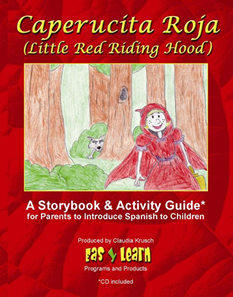
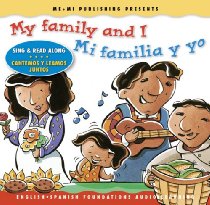
I did not find Christmas Classics in foreign languages available in bookstores, trust me, I looked for it, but I believe you should look at your child’s preferences and classic stories. I wanted to share my activity book, which combines a cd which reads the story in both languages and suggestions on activities in each page!
Many other options are out there like Dora™, Curious George™, and Other famous characters books!
You can also download them in your tablet or computer and have a paperless version of them or do a surprise dowload to your child’s tablet! My son loves comic books and character books, I have found some of his favorites in Portuguese and will download them into his tablet before Christmas!
Itunes has so many options!
Music
It’s always a great way to connect with children! The holidays bring the magic of showing children favorite tunes in different languages!
I have this cd and we always play it on weekends and when we are decorating the tree!
I have a Brazilian Cd with songs in Portuguese with the character Monica, a famous comic book character in Brazil, but I could not find the link to share, I have found this one, not sure why it so hard to find music in Portuguese when you are here in the US! Sharing the songs and culture like the fact that South American countries don’t have stockings but shoes where Santa brings the toys and other traditions I will be sharing in a later post, will bring your child to a magic new world where America traditions are added to the new ones! Priceless!
Basically any movie you purchase nowadays, has the Spanish and French options, so your child can watch the movie in a foreign language. I would recommend showing them the movie in English first, unless they are totally fluent in the second language. You would be surprised how children sit down and watch the elf, Christmas Carol and Mr Magoo in Spanish and love it! Brazil has a different zone for movies, so I purchase my dvds there when I go or in the sendex.net store and load to my laptop as they will not play on my blueray/dvd player!
Toys
Dora, Elmo, Diego, so many toys are now offered with bilingual versions, Dora has a new gymnastics doll which sings in Spanish! So cute!
Clothes
I ordered a shirt on vista print, it is green, long sleeve and it says Feliz Natal! Every year we have a tradicion to wake up in new jammies on Christmas morning and I ordered this shirt for $ 15,00 with the printing in red and will buy the pj bottoms and surprise my son with it! You can also place granparents pics and saying in a foreign language if your in laws or parents are from a foreign country or make the shirt your child/children’s pic in it, place the Merry Christmas in their native language and ship as a Christmas gift! Shipping of a shirt to a country like Brazil is only $ 4,50!
After all, it’s all about bringing the holiday cheer to your children, making the foreign language, a part of it!
We are proud to announce two new satellite class locations!
Moorestown
Open House
Come and join our fun and super cool open house at Kids’ MusicRound Moorestown,330 Young Ave, Moorestown, NJ.
When: Sep 29th
Time: 11:45- 12:45
We will be serving light refreshments, sharing benefits of introducing foreign languages early on and enjoying a super fun demo class and wait, a special guest will be coming to greet us! Guess who?
Free events, all siblings are welcome!
Classes start Oct 18th, 11:00am Mommy and Me class where children and parents will play, sing and enjoy our Spanish Station™ Fun! For ages 14m-36m. Rates are just $ 15.00 per class!
Turnersville
Open House
Come and join our fun and super cool open house at Monkey Town, Turnersville,Whitman Plaza, Turnersville
When: Oct 3rd
Time: 10:30 – 11:30am
We will be serving light refreshments, sharing benefits of introducing foreign languages early on and enjoying a super fun demo class and wait, a special guest will be coming to greet us! Guess who?
Classes start Oct 17th, 10:30am, ages 3-5 years old
Rates start at $ 15.00 per class
We will be sharing our great fall topics, basic themes, music, games and art where Spanish is a synonym of FUN!!! Children will receive a complimentary play time, being able to play on the moon bounces and other attractions after our event!
Come and sign up at the open house and save $25.00 on the enrollment fee!
As back to school is here and my son’s private school opted for Latin instead of Spanish, I started looking for alternatives to keep his summer skills sharp and the Spanish fresh in his mind. I searched for ideas and created some new ways to bring a second language to my child who will be basically exposed to just one language in school.
I hope you enjoy!
1) Game Night –Juegos
Choose your favorite game like scrabble, bingo, any game and create a Spanish version. I have a professional bingo wooden set, we get the popcorn out, my son loves it! Once a month is game night in Spanish!
2) Libros –My son loves buying books, I take him to Barnes and Noble or shop online, for each English book, he needs to chose one in Spanish!
3) Cantar –We download karaoke versions of songs in Spanish and he and I try to sing and do a contest! I connect my laptop to the tv and the songs are on youtube.
4) Comida – Off course food is always a great way to bring Spanish to the table through the amazing dishes,if you need inspiration, visit my cooking blog: www.kcocina.com
5) Hablar – Speaking Spanish at home, on a daily basis, using short sentences if you are not fluent, is off course the most effective way to develop your child’s skills and his/her connection with the language.
If you have more ideas, please share them with us! Would love to hear you!
This week some of our classes had the theme Ropas, we started by learning basic vocabulary:
Vestido – dressPantalones – pants
Shortes/bermudas – shorts
Falda – skirt
Camisa – shirt
Blusa – blouse
Zapatos – shoes
Sandalias – sandals
We then worked on drawing clothes for our ninos y ninas:
The results were amazing and they took home versions which could be altered to review other clothing vocabulary.
Some of the samples below were done by 3/4 year olds!
We played a hide and seek game with clothing items where they won a point if they shouted the name of the item. Encontre la camisa!
We looked at two pictures of a boy and a girl at the beach and talked about what they were wearing. Me gusta el sombrero, no me gustan las sandalias…..
We watched el negro cirilo pro Guia Infantil:
We ended the class looking at what we were wearing and talking about it!
Hope you enjoyed our class! Please let us know! if you wish to download a free coloring page, please click here!
I attended BlogWorld Conference this past week in NYC and BEA, Book Expo and it was an amazing experience to see so many accents and foreign colors represented at the conference and during our time off!
I took my husband and son because it was my son’s request to spend his birthday in NYC, so we enjoyed the best of both worlds! I never imagined the trip would end up giving us a lot more than what we bargained for, such a rich environment for bilingual growth for international learning, it gave me one more reason to come back to NY!
I would spend days sharing all the opportunities we had to share and experience culture exchange, so I will limit this post to our highlights!
My husband and I attended the conference, so my friend generously asked her mom to help us and babysit my son! Little did I know that he would get a lot more than a babysitter! Ita, how he affectionately called her, became a second grandmother, latin way, loving and caring! She not only taught him Spanish those 3 days but brought him Spanish snacks and cooked arroz con frijoles on the last day and introduced him to her lovely family! She enriched his life in a bigger way than she will ever understand! He lost one of his grandmas when he was born and my mom is in Brazil, so Ita filled an empty space in his heart and gave him more reasons to be proud of speaking a foreign language and to learn it! I wished she lived closer!
Our second night in the hotel my son decided to go to the pool and an older German couple came with grand kids, they were talking in German about the water and asking about a shower, dusche….I heard and said to myself, here I go, dust my German spiderwebs and try to help them, this lead into a whole conversation about Brazil and soccer and to my son being able to play with a German child without speaking his language! I could see in my son’s eyes how proud he was of my German, since he had never heard me speak the language; I was surprised myself to remember so many words and to be able to carry a conversation for over 40min with them! At the end my son came back saying spielen…..(play in German), Wasser (water), and other words he picked up! Priceless to see foreign languages in action outside the formal classroom scenario!
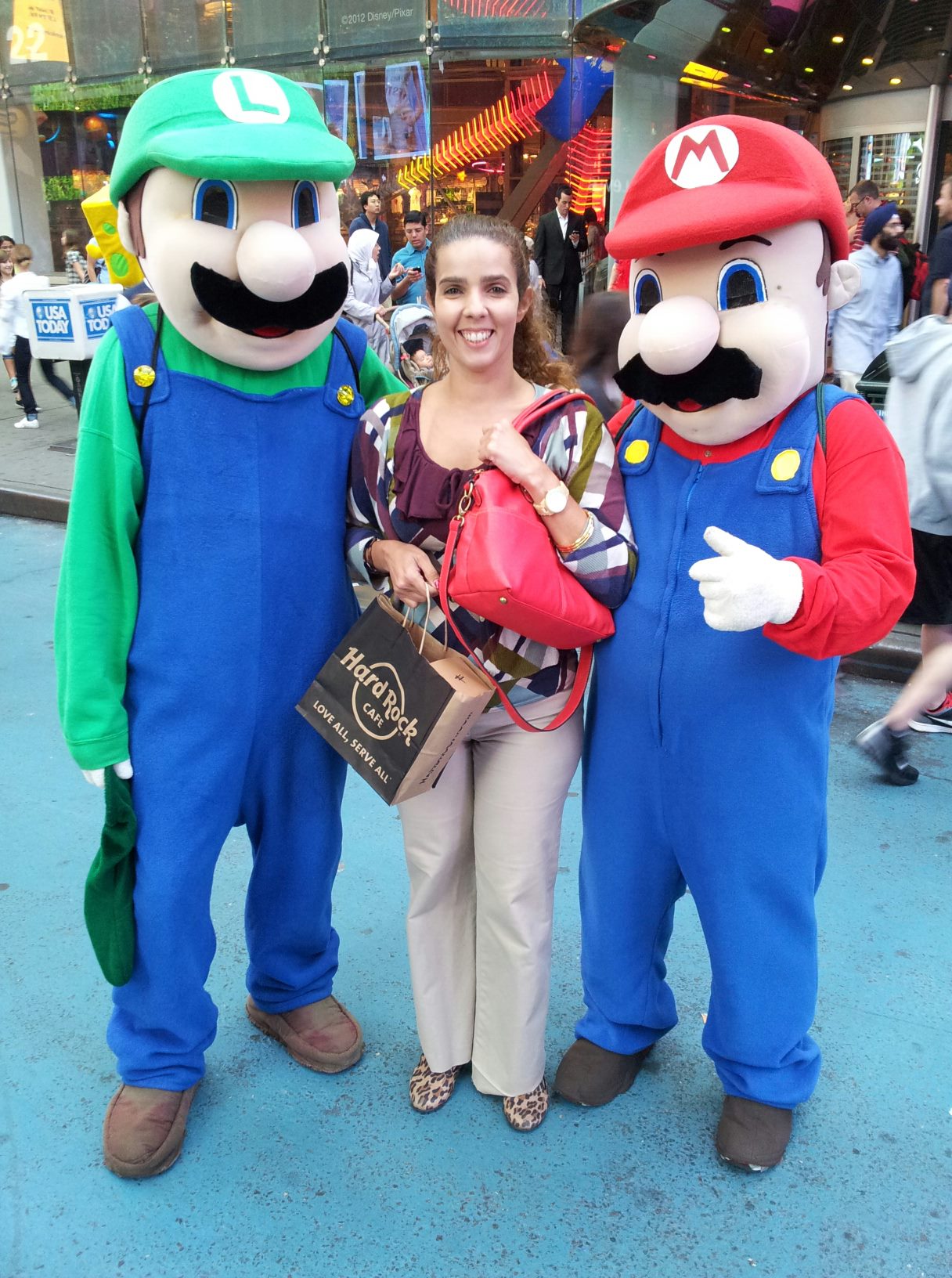
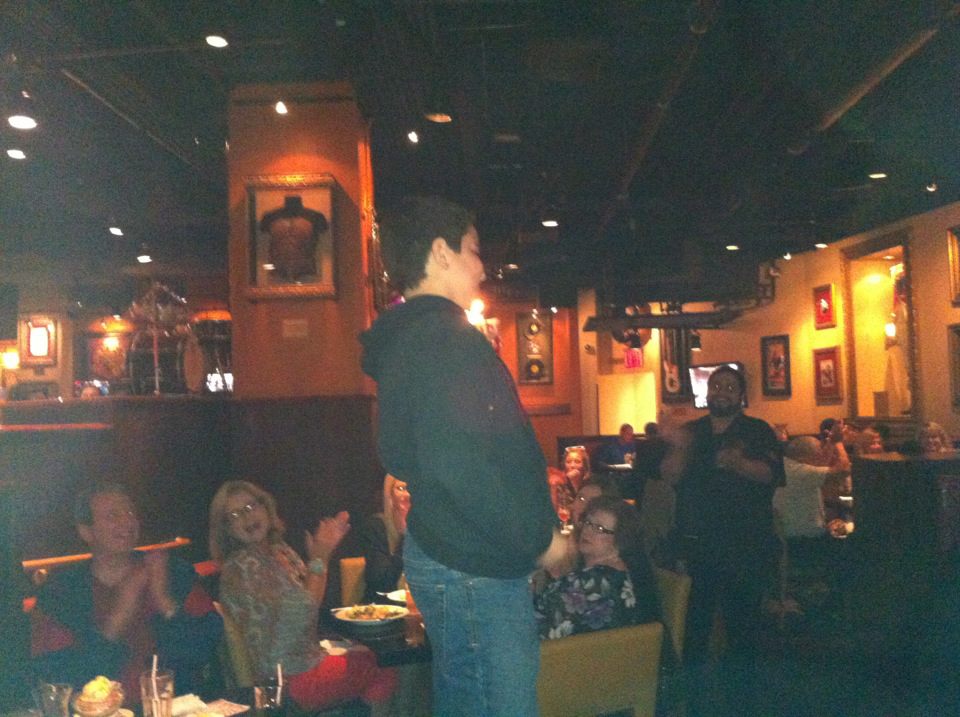
Thursday night we went to HardRock Cafe in Times Square and Toys r us, both places had so many Brazilians, it was unbelievable! It looked like New Year’s Eve there! That’s when I saw Mario and Luigi and tried to teach them some Spanish or Portuguese and they said, Mama Mia!!
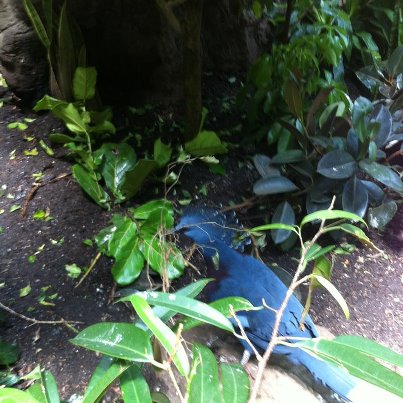
On Friday we went to the Tish zoo in Central Park and the main part of the zoo had a rain forest exhibit with so many birds from South America, I swear, it smelled and felt like Brazil in there! LOL We then, heard all these Brazilians in there and my son jumped, mom, this is Brazilian, why are they speaking Brazilian?? I was also amazed at the amount of Brazilians there! It felt like we were all invited to a party! I showed my son some birds and explained their names in Portuguese. I highly recommend, great activity for children in NYC, great place to teach them a foreign language, Spanish and Portuguese in particular! We saw this Arara and I told my son, call her, ARARA, ARARA! He did and she aswnered! Loved it!
I wanted to visit Macy’s Brazilian exhibit, that will have to wait until August when we return for BlogHer! Can’t wait to share more places bilingual friendly! Hope you enjoyed our journey! My family had a blast! Thinking NY is not for children, think twice!
This past week, we brought a very interesting approach to teaching furniture vocabulary in Spanish.
Children talked about their favorite rooms in their house, using the words learned, they also played domino and go fish with our flashcards.
They played hit or miss with a ball around the room, hitting the pictures that they could identify and watched a great video of the bear in the big blue house, welcoming them to his house!
Our coloring page was a furniture piece in different classes, coloring pages, flashcards and domino are available for sale, please contact us for sample!
The owner of this website, Claudia Krusch, is a participant in the Amazon Services LLC Associates Program, an affiliate advertising program designed to provide a means for sites to earn advertising fees by advertising and linking Easy Learn Languages Blog to Amazon properties including, but not limited to, amazon.com, endless.com, myhabit.com, smallparts.com, or amazonwireless.com.